AI ATS: The Complete Guide (2026)
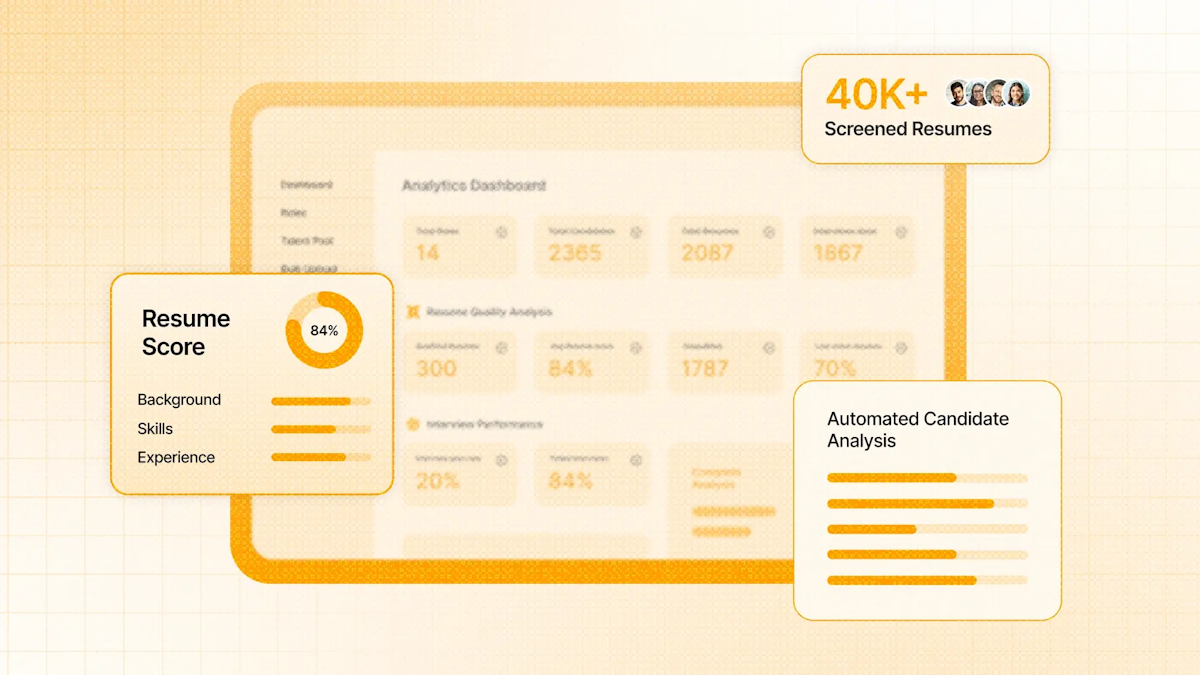
“Half of talent teams now run between two and five paid TA tools in their core hiring stack.”
On paper, that sounds efficient. More tools should mean faster screening, quicker interviews, and shorter time to hire.
But in practice, recruiters still jump back and forth between multiple systems.
They source on LinkedIn, review resumes in an ATS, schedule interviews in a calendar tool, then chase feedback over email and Slack. Even with AI features, hiring still moves step by step: source, screen, schedule, wait.
Meanwhile, candidates apply and hear nothing for days. Hiring managers review profiles in batches. Recruiters follow up and reschedule instead of deciding.
This is why most AI applicant tracking systems feel busy but slow. They automate individual tasks like resume parsing and email templates, but they don't eliminate the waiting between steps.
In this guide, you’ll see how AI ATS platforms behave in real hiring workflows, why speed still breaks down even with automation, and what to look for when evaluating hiring systems beyond feature lists and demos.
You’ll walk away with a clear framework to assess whether an AI ATS will actually shorten your hiring cycle, or just make individual steps feel busier.
What is an AI ATS?
An AI Applicant Tracking System is hiring software that uses artificial intelligence to help recruiters screen, organize, and move candidates through the hiring process.
At a basic level, it does what a traditional ATS does. It collects applications, stores resumes, and tracks candidates through hiring stages.
However, the difference is how the work gets done. An AI ATS uses AI to handle repetitive tasks that recruiters normally do by hand. It can read resumes automatically. It can rank candidates against a job description. It can send status emails. It can help schedule interviews.
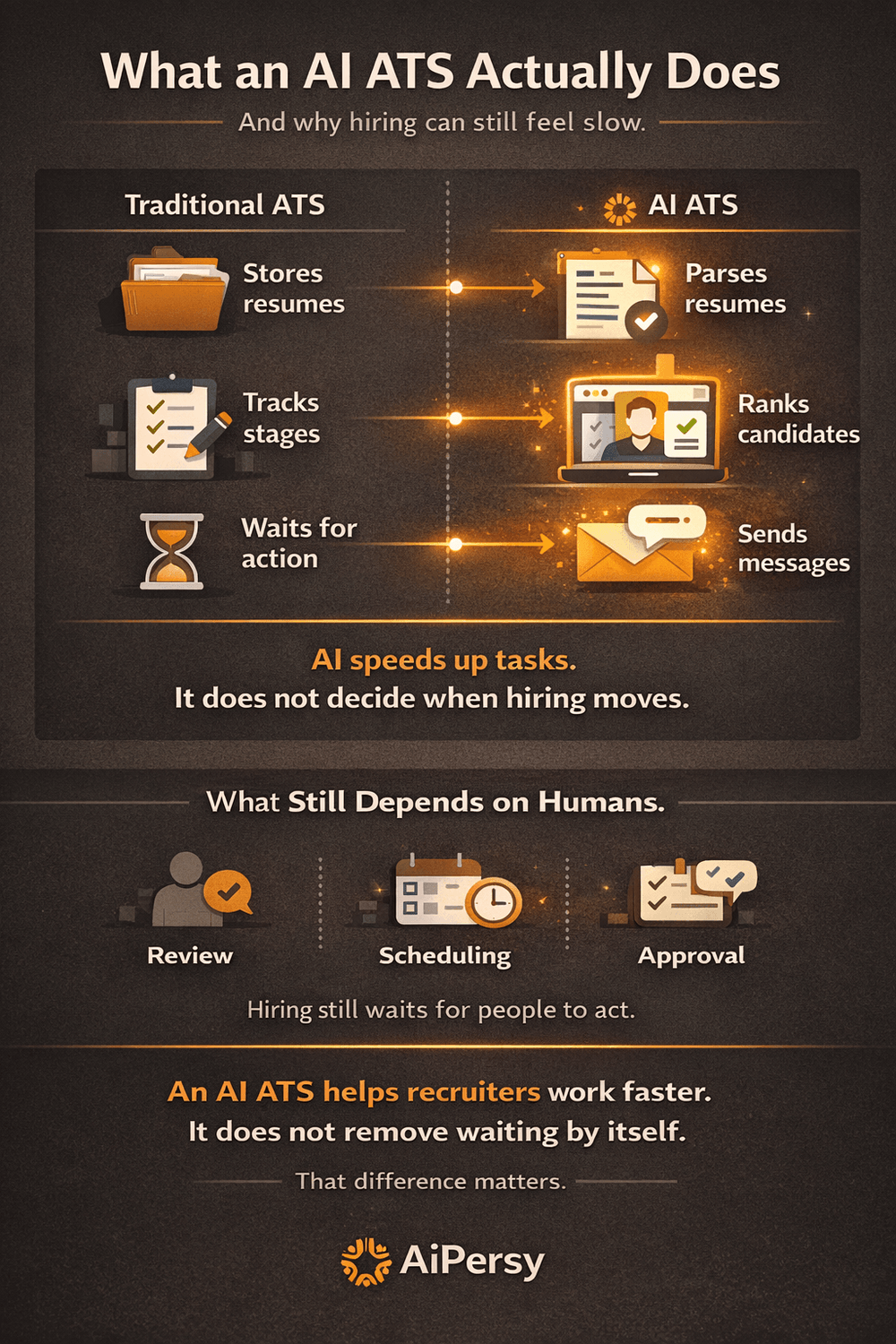
For example:
- Instead of manually scanning resumes, the system parses and scores them.
- Instead of drafting follow-ups, it sends prewritten messages.
- Instead of sorting candidates manually, it highlights likely matches.
This helps talent acquisition teams process more applications with less manual effort.
Most companies adopt an AI ATS to save time, reduce admin work, and manage higher hiring volume. That is what an AI ATS is.
How well it actually speeds up hiring is a different question. And that is where most recruiters run into hiring bottlenecks, which we will explain next.
Why Companies Use AI ATS Today?
According to research, improving candidate quality (47%) and attracting more candidates (52%) were the top two hiring priorities in 2025.
Most hiring teams feel this pressure every day. Application volume keeps rising. Open roles stay live longer. Recruiters are expected to hire faster without sacrificing expectations.
That's where AI ATS platforms take charge. They adopt AI-powered ATS tools for the following practical reasons:
Speed and efficiency: As compared to traditional tools, AI ATS can screen thousands of resumes in minutes instead of days. It automates keyword matching, identifies relevant skills, and surfaces top candidates without manual sorting.
Better candidate matching: Beyond simple keyword searches, AI analyzes transferable skills, career patterns, and multidimensional fit. This, in turn, aids recruiters in finding candidates they might have missed manually.
Improved candidate experience: Thanks to the advent of OpenAI, because of which, we all know that AI chatbots can answer questions instantly.
When it comes to hiring, AI-powered recruiting tools provide automated updates to keep candidates, recruiters, and hiring managers in sync.
Interview scheduling also takes place without the usual back-and-forth of checking calendars for stakeholders and candidates. As a result, these hiring experiences feel more responsive and professional.Reduced unconscious bias: AI can anonymize resumes during initial screening, focusing solely on skills and experience of candidates rather than names, schools, or demographics.
Data-driven insights: AI ATS platforms track metrics like time-to-hire, pipeline velocity, and drop-off points. It gives talent acquisition teams visibility into what's working and what's not.
Cost reduction: An AI-powered ATS reduces reliance on manual effort, job board spending, and agency fees, lowering cost-per-hire.
Scalability: AI handles massive applicant volumes without compromising quality, making it essential for high-volume or fast-growing teams.
Benefits of Using an AI ATS
AI-powered applicant tracking systems deliver measurable improvements across every stage of hiring. Here's what teams gain when they adopt one.
Faster Time-to-Hire
The AI ATS tools automate the most time-consuming parts of recruiting, which are resume screening, scheduling, and candidate communication. Tasks that used to take days now happen in minutes.
Companies report cutting time-to-hire by 40-60%, moving from 6-8 weeks to 2-3 weeks on average. For high-volume roles or competitive markets, that speed advantage matters.Better Candidate Matching
AI goes beyond keyword searches. It analyzes skills, experience, and qualifications at scale, identifying candidates who match your needs across multiple dimensions.
Even when they use different terminology from your job description. This improves the quality of hire for any given role. And that’s how the right and deserving candidates rise to the top instead of getting filtered out by rigid keyword rules.
Improved Candidate Experience
In this AI-driven era, candidates expect fast and transparent communication, and this is where AI-powered ATS tools come in handy.
Their AI-driven chatbots resolve queries 24/7, while these tools also push automated updates to keep candidates informed at every stage.
In addition, their self-scheduling functionality allows candidates to book interviews without any human intervention.
As a result, a better candidate experience strengthens your employer brand and increases offer acceptance rates, even among candidates you don’t hire.
Reduced Unconscious Bias
AI can anonymize resumes during initial screening, removing names, photos, schools, and other signals that may trigger unconscious bias. Candidates are evaluated on skills and qualifications first.
When configured properly, this leads to more diverse candidate slates and fairer early-stage hiring outcomes.
AI can anonymize resumes during initial screening, removing names, photos, schools, and other information that might trigger unconscious bias. The system evaluates candidates based on skills and qualifications alone.
When configured properly, this leads to more diverse candidate slates and fairer hiring outcomes.
Data-Driven Insights
AI ATS platforms track metrics like time-to-hire, source effectiveness, candidate drop-off points, and pipeline velocity.
This visibility equips HR professionals to identify bottlenecks and optimize their recruiting strategies.
Thus, instead of relying on gut feelings, recruiters make decisions backed by real data.
Cost Reduction
In the hiring industry, most costs come from manual work, such as job board spend, agency fees, and recruiter hours lost to coordination.
AI ATS tools reduce that overhead. By automating screening, scheduling, and follow-ups, companies report lowering cost-per-hire by 30–50% after implementation.
Furthermore, better matching also reduces turnover. When candidates align more closely with role requirements, they stay longer, eradicating the hidden costs of backfilling and re-hiring.
Scalability
AI handles massive application volumes without compromising quality or speed.
Whether you're hiring for 5 roles or 500, the system evaluates every candidate consistently. For fast-growing companies or seasonal hiring spikes, this scalability is essential.
Freed-Up Recruiter Time
By handling repetitive tasks in a recruitment funnel, such as resume parsing, screening, scheduling, and job application status updates.
AI removes the administrative burden that keeps recruiters stuck in the coordination cycle. As a result, when recruiters spend less time on manual work, they can move from a reactive, administrative function to a strategic, proactive role.
Instead of drowning in logistics, they focus on aligning hiring with business goals, developing talent strategies, and acting as trusted advisors to leadership.
HR stops being the team that "fills roles." It becomes the team that understands what the business needs next, who can deliver it, and how to find them.
How does an AI ATS work?
Understanding how an AI ATS processes candidates explains why hiring still slows down, even with automation.
Here is what happens when a candidate applies.
Step 1: Application Intake and Resume Parsing
It converts the document (PDF, Word, etc.) into machine-readable text. Then it extracts structured data such as name, contact info, work history, education, skills, and certifications.
Modern AI ATS platforms use Natural Language Processing (NLP) to understand the context of the job description instead of just matching keywords.
If your resume says "led a team of 5," the system infers leadership experience even if you never wrote the word "leadership."Step 2: Candidate Scoring and Ranking
Next, the AI compares your profile against the job requirements. It assigns a relevance score based on how well a candidate’s skills, experience, and qualifications match what the role needs.
Although few of the AI-driven ATS tools use weighted scoring, meaning "5 years of Python" might count more heavily than "excellent communication skills" for a developer role.
The AI doesn't just look for exact keyword matches. It recognizes synonyms, related skills, and transferable experience. If the job asks for "project management" and your resume says "led cross-functional initiatives," a good AI ATS connects the dots.
Step 3: Automated Communication
Once candidates are in the system, AI handles routine touchpoints.
For example, it sends application confirmations and updates candidates on their status.
Even though in some AI hiring platforms, AI chatbots answer common questions like ("When will I hear back?" or "What's the interview process like?") instantly.
This keeps candidates engaged without requiring recruiter intervention.
Step 4: Interview Scheduling
For candidates who pass the initial screening, the AI can coordinate interview times.
Some systems integrate with calendars, sending availability options to candidates and automatically booking time slots without requiring email confirmation, previously the biggest pain point for every recruiter.
Step 5: Candidate Ranking and Presentation
Finally, the AI presents a ranked shortlist to recruiters and hiring managers.
The dashboard highlights the top matches, displays relevance scores, and surfaces key qualifications. Recruiters can see who scored the highest and understand why through detailed explanations.
Key features to look for in an AI ATS Tool
Not all AI ATS platforms are built the same. When evaluating options, focus on these core capabilities that determine how well the system will actually work for your recruiters or TA teams.
AI-Powered Resume Screening and Parsing
The tool should automatically extract candidate information from resumes, such as contact details, work history, skills, and education, and structure it into searchable profiles.
Advanced AI ATS platforms use Natural Language Processing (NLP) to understand context, not just match keywords.
If a job requires "project management" and a resume says "led cross-functional initiatives," a good AI ATS makes the connection.Therefore, always for AI ATS software that can rank candidates based on relevance scores, instantly surfacing top matches.
Automated Candidate Communication
An AI recruiter tool or an AI ATS should handle routine touchpoints automatically, which include application confirmations, status updates, interview reminders, and follow-ups.
Some platforms include chatbots that answer candidate questions 24/7, like "When will I hear back?" or "What's the interview process like?" without any recruiter intervention.
This keeps candidates engaged and informed without adding to your team's workload.
Interview Scheduling and Calendar Integration
The AI ATS software that you’re looking for must integrate with Google Calendar, Outlook, Calendly, or other scheduling tools to coordinate interview times automatically.
Always look for self-scheduling features where candidates can book from available time slots. This eliminates the back-and-forth long email threads that used to consume hours of recruiter time.Collaboration Tools and Role-Based Access
A recruitment funnel involves contributions from multiple stakeholders. Therefore, your AI ATS should support shared feedback, scorecards, and candidate evaluations visible to the entire hiring team.
Such role-based permissions ensure sensitive information (like salary details or internal notes) stays visible only to the right people.
Analytics and Reporting Dashboards
An AI ATS platform should consistently track key metrics essential for every recruiter, such as time-to-hire, source effectiveness, candidate drop-off points, pipeline velocity, and diversity statistics.
Always look for customizable dashboards that visualize trends and hiring bottlenecks, helping you optimize your recruitment strategy over time.Integrations with Your HR Tech Stack
Your AI ATS should connect with the tools you already use, including HRIS systems, background check services, assessment platforms, video interview software, and communication tools like Slack.
These seamless integrations prevent data silos, increase efficiency, and eliminate duplicate data entry.
Compliance and Data Security
A fully fledged AI ATS software must support employment regulations and data protection laws such as GDPR, EEOC, OFCCP compliance, candidate consent management, and audit trails.
Therefore, look for features like automatic data purging, anonymization options, and permission controls that protect candidate information from privacy hazards.
Mobile Accessibility
Last but not least, your hiring teams should be able to review candidates, leave feedback, and approve decisions from their smartphones. As well as, candidates should be able to apply easily from mobile devices.
The right AI ATS should automate repetitive work, improve collaboration, and provide the data you need to hire better, without adding complexity or losing control.
When evaluating such hiring platforms, prioritize features that solve your specific hiring challenges, like high volume, remote coordination, compliance requirements, or speed.
Traditional ATS vs AI ATS
Understanding the difference between a traditional ATS and an AI-powered ATS helps explain why adding automation doesn't always solve hiring speed. Here's how these two systems compare.
| Aspect | Traditional ATS | AI ATS |
| Primary Function | Data storage and workflow tracking | Intelligent analysis and automation |
| Resume Screening | Keyword matching (rigid, often misses qualified candidates) | Contextual understanding using NLP (recognizes synonyms, transferable skills) |
| Automation | Limited (basic email templates, calendar syncing) | Extensive (screening, scheduling, engagement, ranking) |
| Candidate Matching | Manual review required | AI scores and ranks candidates automatically |
| Insights | Basic reports (time-to-fill, source of hire) | Predictive analytics (performance forecasts, retention predictions) |
| Bias Risk | Can perpetuate bias through keyword rules and manual filtering | Aims to reduce bias (but algorithms must be audited) |
| Scalability | Struggles with high volume | Handles thousands of applications efficiently |
| Best For | Low-volume hiring, basic compliance needs | Growth-focused teams, high-volume hiring, speed-critical roles |
What a traditional ATS does
A traditional ATS is essentially a digital filing cabinet that centralizes candidate information and manages hiring workflows. Its core functions include:
- Job posting and distribution
- Resume storage and basic parsing
- Interview scheduling
- Candidate communication tracking
- Compliance documentation
- Basic reporting
Traditional ATS platforms rely heavily on manual input. Whether it’s reviewing resumes, scheduling interviews, or obtaining approval from hiring managers, these tools always require human intervention to move candidates to the next stage of the recruitment funnel.
What an AI ATS Does
An AI-powered ATS goes beyond storage and tracking. It uses machine learning and Natural Language Processing (NLP) to actively enhance hiring decisions.
These software:
- Understand context in resumes, not just keywords
- Predict candidate fit based on skills and experience patterns
- Automate screening, follow-ups, and interview coordination
- Engage candidates through chatbots and real-time updates
- Learn from hiring outcomes to improve matching over time
Instead of simply organizing data, AI ATS platforms analyze it by surfacing insights, ranking candidates, and automating decisions where appropriate.
Key features to look for in an AI ATS Tool
Not all AI ATS platforms are built the same. When evaluating options, focus on these core capabilities that determine how well the system will actually work for your recruiters or TA teams.
AI-Powered Resume Screening and Parsing
The tool should automatically extract candidate information from resumes, such as contact details, work history, skills, and education, and structure it into searchable profiles.
Advanced AI ATS platforms use Natural Language Processing (NLP) to understand context, not just match keywords.
If a job requires "project management" and a resume says "led cross-functional initiatives," a good AI ATS makes the connection.Therefore, always for AI ATS software that can rank candidates based on relevance scores, instantly surfacing top matches.
Automated Candidate Communication
An AI recruiter tool or an AI ATS should handle routine touchpoints automatically, which include application confirmations, status updates, interview reminders, and follow-ups.
Some platforms include chatbots that answer candidate questions 24/7, like "When will I hear back?" or "What's the interview process like?" without any recruiter intervention.
This keeps candidates engaged and informed without adding to your team's workload.
Interview Scheduling and Calendar Integration
The AI ATS software that you’re looking for must integrate with Google Calendar, Outlook, Calendly, or other scheduling tools to coordinate interview times automatically.
Always look for self-scheduling features where candidates can book from available time slots. This eliminates the back-and-forth long email threads that used to consume hours of recruiter time.
Collaboration Tools and Role-Based Access
A recruitment funnel involves contributions from multiple stakeholders. Therefore, your AI ATS should support shared feedback, scorecards, and candidate evaluations visible to the entire hiring team.
Such role-based permissions ensure sensitive information (like salary details or internal notes) stays visible only to the right people.
Analytics and Reporting Dashboards
An AI ATS platform should consistently track key metrics essential for every recruiter, such as time-to-hire, source effectiveness, candidate drop-off points, pipeline velocity, and diversity statistics.
Always look for customizable dashboards that visualize trends and hiring bottlenecks, helping you optimize your recruitment strategy over time.
Integrations with Your HR Tech Stack
Your AI ATS should connect with the tools you already use, including HRIS systems, background check services, assessment platforms, video interview software, and communication tools like Slack.
These seamless integrations prevent data silos, increase efficiency, and eliminate duplicate data entry.
Compliance and Data Security
A fully fledged AI ATS software must support employment regulations and data protection laws such as GDPR, EEOC, OFCCP compliance, candidate consent management, and audit trails.
Therefore, look for features like automatic data purging, anonymization options, and permission controls that protect candidate information from privacy hazards.
Mobile Accessibility
Last but not least, your hiring teams should be able to review candidates, leave feedback, and approve decisions from their smartphones. As well as, candidates should be able to apply easily from mobile devices.
The right AI ATS should automate repetitive work, improve collaboration, and provide the data you need to hire better, without adding complexity or losing control.
When evaluating such hiring platforms, prioritize features that solve your specific hiring challenges, like high volume, remote coordination, compliance requirements, or speed.
Common myths about AI ATS (And why they persist)
One of the loudest myths in hiring today sounds like this: "Your resume was rejected by AI before a human ever saw it."
Recruiters know this is mostly false. And candidates believe it because they apply on Monday and hear nothing until Friday, including a series of no status updates, no explanations, and no human contact at all.
Here's what actually happens.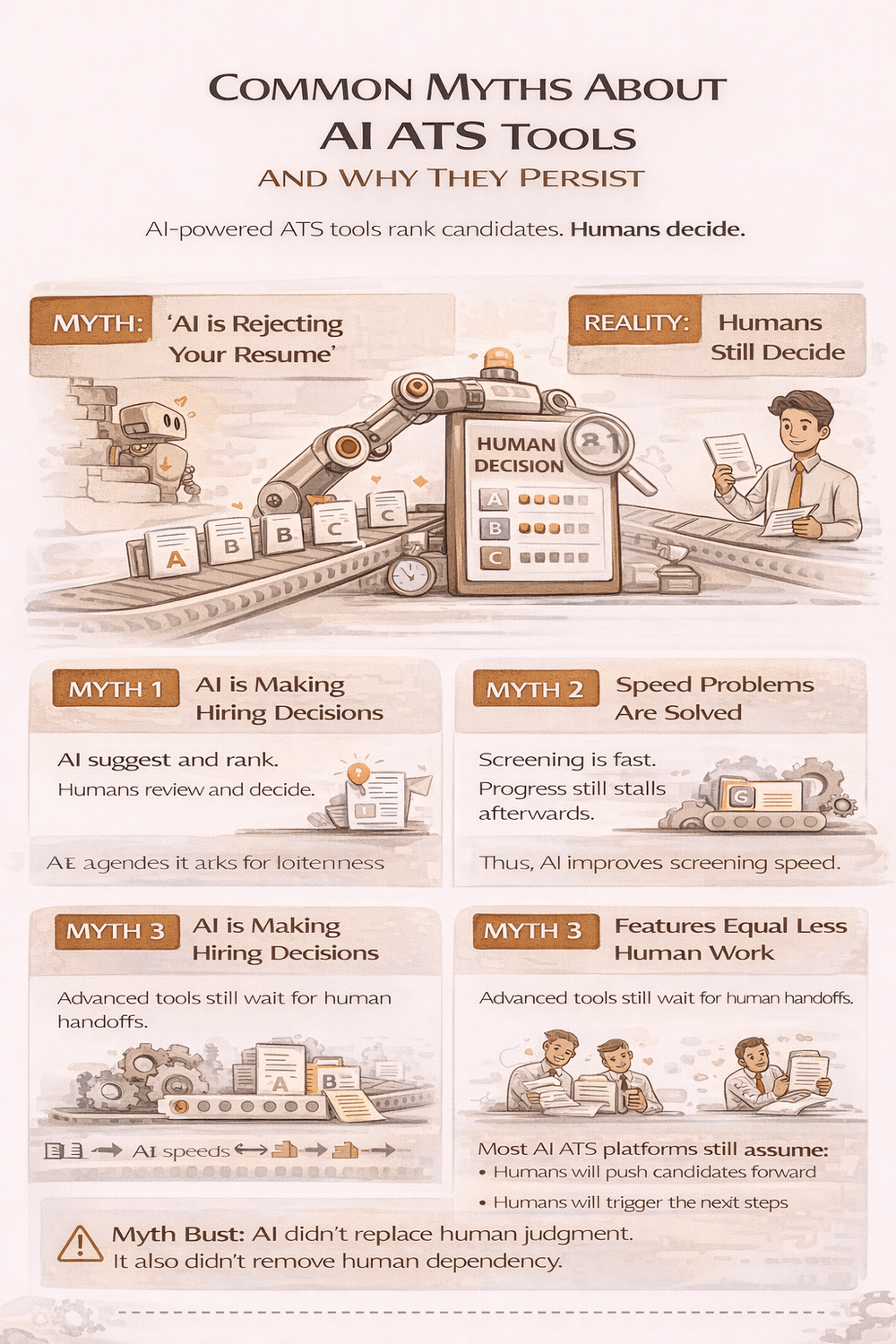
Most ATS platforms do not auto-reject candidates. They parse resumes. They highlight keywords. They rank profiles. Humans still decide. Recruiters skim. Hiring managers review. Shortlists get created manually.
The real issue is not AI replacing judgment. It is AI failing to remove dependency on judgment.
Myth 1: "AI Is Making Hiring Decisions"
In practice, AI rarely decides anything. It suggests. It ranks. It flags. Then friction begins to occur in the recruitment funnel.
A recruiter still has to open the ATS. A hiring manager still has to review the list. Calendars still have to align. So candidates don't get rejected instantly. They get stuck silently.
Myth 2: "If AI Screening Exists, Speed Problems Are Solved"
In hiring, resume screening is rarely the delay. Because, in many talent acquisition teams, resumes are screened within hours. The pause happens after that.
Candidates wait for:
- Manager review
- Interview scheduling
- Feedback consolidation
- Next-round coordination
Thus, AI improves screening speed. It does not decide when interviews begin. So the funnel still stalls.
Myth 3: "More AI Features Mean Less Human Work"
This is where confusion turns costly. Most AI ATS platforms still assume:
- Humans will push candidates forward
- Humans will trigger the next steps
- Humans will coordinate progress
When hiring volume increases, humans batch. When humans batch, candidates wait.
The Reality Recruiters Quietly Agree On
Hiring does not slow down because resumes are unread. It slows down because progress depends on someone being available.
Until recruitment funnels stop relying on sequential handoffs, AI will help recruiters work harder, not move the recruitment funnel faster.
The checklist to evaluate AI ATS tools for your company
Most talent acquisition teams evaluate AI hiring platforms the same way they evaluate other software. They compare features. They watch demos. They ask about integrations.
That approach misses the real risk. Because most hiring failures do not come from missing features, they stem from hidden waiting already present in the system.
Here is how to evaluate an AI ATS without repeating the same mistake.
Ask What Triggers Movement
Start with one simple question: What causes a candidate to move forward without a human nudge? Many tools automate actions inside different hiring stages:
- Resume parsing
- Email templates
- Calendar syncing
- Interview reminders
But still requires a recruiter to:
- Review
- Approve
- Trigger
- Push
If a hiring software only moves when someone clicks "next," it will slow down the moment you hire for 5 roles at once, or process 200 resumes in a week. No matter how advanced the AI sounds.
Trace a Single Candidate End to End
Most demo sessions focus on what the system can do: AI screening, automated emails, and smart scheduling.
Few show what happens between those features. Do not ask for feature lists. Ask the vendor to walk one real candidate through the system.
Specifically:
- When does screening finish?
- What happens next automatically?
- Where does the candidate wait?
- Who has to react for progress to continue?
If the answer includes phrases like:
- "Once the recruiter reviews…"
- "After the hiring manager approves…"
- "When calendars align…"
It means you are looking at a sequential system with AI layered on top.
Look for Parallelism, Not Speed Claims
Many vendors promise:
- Faster screening
- Faster scheduling
- Faster communication
In hiring scenarios, speed claims are easy to make. However, flow is harder to design. Instead, look for signs of parallel execution:
- Can resumes be evaluated continuously as they arrive?
- Can interviews happen without a recruiter's intervention?
- Can rankings update without batch reviews?
If progress still waits for stages to finish, speed will never compound within your recruitment funnel.
Demand Explainability at the Role Level
AI should not decide who gets hired. But it must explain why candidates move forward. Ask:
- Can recruiters define role criteria upfront?
- Are thresholds explicit and adjustable?
- Can every score be traced back to the role definition?
If decisions feel opaque or hard to explain to a hiring manager, trust will erode quickly.
Evaluate What Humans No Longer Have to Do
The most honest test is about the practical ease of the AI ATS software.
Ask your recruiters:
- Will this reduce follow-ups?
- Will this remove first-round coordination?
- Will this eliminate waiting between steps?
If the answer is "it helps, but…" the system likely makes individual tasks faster while leaving the waiting between steps unchanged.
A modern hiring system does not make recruiters faster at coordination. It removes coordination entirely where judgment is not required.
Hiring challenges that an AI ATS solves
AI ATS platforms were built to address specific, recurring hiring challenges that slow teams down. Here are the core problems they help solve.
Managing High Application Volume
Popular roles generate hundreds of applications within days. A single software engineer posting can pull in 500+ resumes. Healthcare positions attract thousands of candidates during peak hiring seasons.
Manual screening becomes impossible at this scale. Recruiters spend hours reading resumes only to find that most candidates don't meet basic requirements. Hence, the top talent pays the price; their resumes get buried in the noise.
AI ATS platforms handle this by:
- Automatically parsing and evaluating resumes against job criteria
- Ranking candidates by relevance score
- Surfacing qualified candidates instantly
Instead of reviewing 500 resumes manually, recruiters start with a pre-screened shortlist of 20-30 strong matches.
Reducing Time-to-Hire
In the hiring industry, speed wins placements. Consider this: the best candidates have multiple offers. And, the agency or company that gets them in front of a hiring manager first usually wins.
Yet traditional hiring moves slowly. Interview scheduling alone can take days of back-and-forth emails. Even the interview feedback gets delayed. Approvals wait for weekly meetings.
However, AI ATS platforms compress timelines by:
- Automating interview scheduling (candidates self-schedule from available slots)
- Sending instant status updates to keep candidates engaged
- Removing coordination delays that stretch hiring cycles
Companies using AI-powered ATS report cutting time-to-hire by 40-60%, moving from 6-8 weeks to 2-3 weeks on average.
Improving Candidate Experience
When it comes to hiring, candidates never ask for instant offers. However, they do expect timely communication.
But in reality, we hear this every day that most candidates apply and hear nothing for days or weeks. This silence damages the employer brand and causes drop-offs.
Even 70% of technical workers have multiple job offers when they accept a position. Hence, poor or untimely communication always drives candidates to other employers.
Ensuring Compliance and Data Accuracy
Staffing agencies and enterprise companies operate under GDPR, EEOC, and state labor regulations. Documentation requirements, however, vary by jurisdiction across countries.
And, manual tracking often creates compliance gaps: for example, incomplete candidate consent forms, inconsistent data entry among recruiters, or missing interview notes. Auditors identify these gaps quickly, and violations can be costly.
AI ATS platforms address this by:
- Capturing required documentation automatically (GDPR consent, EEOC data)
- Creating audit trails of all candidate interactions
- Enforcing data validation rules to prevent incomplete records
- Centralizing compliance tracking across teams and locations
This protects companies from regulatory risk while reducing administrative burden on HR teams.
Providing Data-Driven Hiring Insights
Most recruiting teams make sourcing decisions based on hunches.
For example, one day LinkedIn may feel productive, Indeed might deliver volume, and referrals could bring better candidates.
However, few teams track which channels actually produce hires who stay.
This creates expensive blind spots. Companies spend thousands on job board premium packages that generate weak candidates while overlooking channels that consistently deliver quality.
AI ATS platforms reveal what's working through:
- Source-of-hire tracking (which job boards, referrals, or agencies deliver the best candidates)
- Conversion rate analysis by recruiter, role, and client
- Bottleneck identification (where candidates drop off or get stuck)
- Quality-of-hire metrics (performance and retention data)
Companies implementing data-driven hiring strategies see a 40% increase in talent pipeline quality and a 22% rise in hire quality.
Reducing Unconscious Bias
Bias in hiring isn't always intentional, but it's always risky. Traditional screening relies on keyword matches and manual filtering, which can unintentionally favor certain backgrounds.
Studies show that candidates with employment gaps or non-traditional education paths are often filtered out by rigid ATS rules, despite being highly qualified.
AI ATS platforms aim to reduce bias by:
- Anonymizing resumes (removing names, photos, schools during initial screening)
- Evaluating candidates against defined criteria, not personal preferences
- Creating structured, audit-ready hiring decisions
- Tracking diversity metrics throughout the pipeline
When configured properly, AI helps build more diverse candidate slates and fairer hiring outcomes.
Top 10 AI ATS Tools
The AI ATS market is crowded with numerous options. Most of the SERP pages are loaded with AI ATS platforms that promise faster hiring, smarter screening, and an improved candidate experience.
In reality, each tool solves one part of the hiring problem very well, but leaves other areas untouched.
Here are ten widely used AI ATS platforms, along with what they genuinely do well and where teams consistently encounter limitations.
AiPersy
Best for: Eliminating waiting between hiring stages in a recruitment funnel.
Why it exists: AiPersy is designed to help recruiters complete tasks more quickly. Adding an extra edge, it is purpose-built by experts who understand the recruitment industry inside out to eliminate the need for recruiters to manually push candidates forward. Here’s how it's different from the rest of the AI ATS available in the market:
Role-first evaluation: Recruiters define qualification thresholds upfront (e.g., 65%). Every resume is measured against that standard automatically.
Parallel processing: Resumes are screened, interviews are conducted, and rankings are updated, all simultaneously, without human gatekeeping.
Asynchronous interviews: Candidates who pass screening receive interview links instantly. They complete interviews on their schedule without any calendar coordination.
Continuous ranking: As interviews are completed, the dashboard updates in real time. Hiring managers see ordered shortlists immediately, not in weekly batches.
2. Workable
Best for: Resume screening and job distribution
Why teams choose it: Workable excels at getting volume into the funnel and reducing early resume review effort. AI-powered recommendations, wide job board reach, and clean collaboration tools make it popular with SMBs and mid-sized teams.
Where friction appears: The current users actively report that screening is fast, but progress is not. Candidates still wait for recruiter review and manager approval before anything moves.
Best fit: Small to mid-sized teams hiring steadily, not urgently.
3. Pinpoint
Best for: Structured candidate evaluation
Why teams choose it: Pinpoint lets teams define custom scoring fields and run consistent evaluations across roles. Hiring managers like the clarity and structure.
Where friction appears: Configuration takes effort. Automation still stops at “review required.”
Best fit: Process-driven orgs that value consistency over speed.
4. Manatal
Best for: AI-native matching for SMBs
Why teams choose it: Manatal’s AI recommendations and social profile enrichment reduce manual sourcing and shortlisting work.
Where friction appears: User experience feels dense. Teams report slower support when workflows break.
Best fit: Growing teams willing to trade polish for AI-assisted shortlisting.
5. Recruit CRM
Best for: ATS + CRM for agencies
Why teams choose it: Recruit CRM connects candidates, clients, and jobs in one place. AI scoring helps agencies shortlist faster.
Where friction appears: Automation helps tasks, not handoffs. Recruiters still push candidates stage by stage.
Best fit: Staffing agencies managing many parallel client pipelines.
6. CEIPAL
Best for: Workforce + recruitment operations
Why teams choose it: Strong analytics, credential tracking, and operational depth for staffing-heavy orgs.
Where friction appears: Setup is complex. Customization is limited once deployed.
Best fit: Large staffing firms prioritizing compliance and reporting.
7. Breezy HR
Best for: Job advertising automation
Why teams choose it: One-click job distribution and clean career pages make it easy to attract applicants quickly.
Where friction appears: Reporting and AI depth are basic. Scaling beyond early growth becomes difficult.
Best fit: Early-stage companies focused on inbound volume.
8. Recruitee
Best for: Team collaboration
Why teams choose it: Role-based access, shared feedback, and collaborative pipelines help distributed teams stay aligned.
Where friction appears: Advanced analytics and AI insights are limited. Coordination still depends on people responding.
Best fit: Teams hiring collaboratively across departments.
9. JazzHR
Best for: Small business hiring
Why teams choose it: Affordable, easy to adopt, and sufficient for low-volume hiring.
Where friction appears: Search, AI screening, and analytics remain basic.
Best fit: Small teams hiring occasionally.
10. SmartRecruiters
Best for: Enterprise-scale hiring
Why teams choose it: Strong governance, approvals, permissions, and global compliance support.
Where friction appears: Configuration is heavy. Speed suffers when approvals stack up.
Best fit: Large enterprises optimizing for control, not velocity.
Final Words
AI ATS platforms have improved hiring in visible ways.
Resumes get screened in seconds. Interviews get scheduled without email ping-pong. Candidate data stays organized across stages.
But most of these improvements happen inside individual tasks, not across the full hiring timeline.
Throughout this guide, we've seen the same pattern:
- Traditional ATS platforms track stages but don’t move candidates forward
- AI features speed up tasks but leave handoffs untouched
- Delays are inevitable when reviews, approvals, or calendar coordination are required
When resumes are evaluated continuously, interviews happen instantly, rankings update in real time, and managers see ordered shortlists immediately. That’s when speed compounds. That’s when time-to-hire drops from weeks to days.
Thus, if you're evaluating AI ATS platforms today, ask the right question:
Not "How intelligent is the AI?"
But "How much waiting does this system remove from my hiring funnel?"
Because hiring doesn't slow down when tasks are manual. It slows down when progress depends on someone being available.
Ready to see what hiring looks like when waiting is removed?
Explore AiPersy →