How AI Interviews Reduce Time-to-Hire by 70%
Nearly every department across your organization, from marketing to sales, tech, or operations. All of them are executing tasks faster than ever, thanks to AI.
Meanwhile, your hiring teams are still stuck using ATS recruitment tools, which deliver them thousands of new job applications every morning.
And the matter of fact is, the real work comes after that, which includes screening candidates, scheduling or rescheduling calls, summarizing interviews, and aligning shortlists with hiring managers.
Ironically, while the rest of the business processes accelerate, your talent acquisition teams have no choice but to operate in a workflow that simply can’t keep up.
However, leading businesses have already recognized this gap and are addressing it by equipping their talent recruitment teams with fully-fledged AI hiring software.
So what is an AI interviewer? How does it reduce the time-to-hire for recruitment teams globally? In this quick read, we’ll uncover what AI interviewing really means.
Where do hiring teams lose the most time today?
Let’s start reading.
What is an AI hiring tool?
An AI interviewer is an automated, agentic hiring system that automates the entire recruitment process from top to bottom and allows hiring managers to engage with top candidates meaningfully.
It conducts the first round of interviews on behalf of human interviewers.
Also, it takes care of other recurring tasks that typically consume hours, such as scheduling and rescheduling, summarising the candidate’s profile, shortlisting applications based on the candidate’s responses, and aligning them with hiring managers.
Consider it as your virtual recruiter that handles the slowest, most repetitive parts of your hiring funnel, doing so instantly, consistently, and at scale.
Naturally, many talent acquisition professionals wonder how capable an AI interviewer actually is.
How does it analyze a candidate? Will it understand nuanced responses? Will it ask generic questions? And, the answer lies in how you configure it.
When you set up an AI interviewer, as an HR professional, you have to define it with a few parameters like job knowledge, communication skills, problem-solving ability, domain familiarity, and more.
This becomes the foundation of how it evaluates every candidate.
As a result, instead of asking surface-level or generic questions, the agentic AI interviewer conducts the screening.
It runs structured conversations with candidates through text, audio, video, or a virtual avatar.
And, it evaluates each response against the competencies you selected, ensuring that every candidate is assessed through the same lens, without any inconsistency or fatigue.
How AI Interviews Reduce Time-to-Hire
The time-to-hire never bubbles up because recruiters work slowly.
It expands because hiring processes are built around multiple small delays that compound at every stage of the recruitment funnel.
And leading brands have already adopted AI interviewer agents to remove these bottlenecks and ditch the manual systems.
But how exactly do AI interviews help talent recruitment teams reduce time-to-hire by up to 70%?
What changes inside the funnel, and where does the time actually get saved? Let’s break it down.
AI hiring software schedules interviews instantly
In most recruiting workflows, the first delay always starts with scheduling.
A simple screening call that should take twenty minutes ends up taking three to seven days because the recruiter and candidate struggle to align on a time.
Time zones, busy calendars, no-shows, last-minute conflicts, and other relevant factors only add friction before the interview even begins.
Therefore, AI interviewing eliminates this delay entirely by removing scheduling from the process.
Instead of waiting for availability or juggling calendars, candidates can take the interview whenever they’re ready, often within minutes of applying.
This single shift eliminates the earliest and largest delay in hiring, allowing the funnel to start moving forward immediately.
AI conducts screening interviews automatically
Screening calls consume a significant amount of time in a recruiter’s week. Even when they are short, each one requires preparation, conversation, note-taking, and administrative follow-through.
And if you multiply this across numerous pending job applications, the entire workday vanishes before the process even reaches the hiring manager.
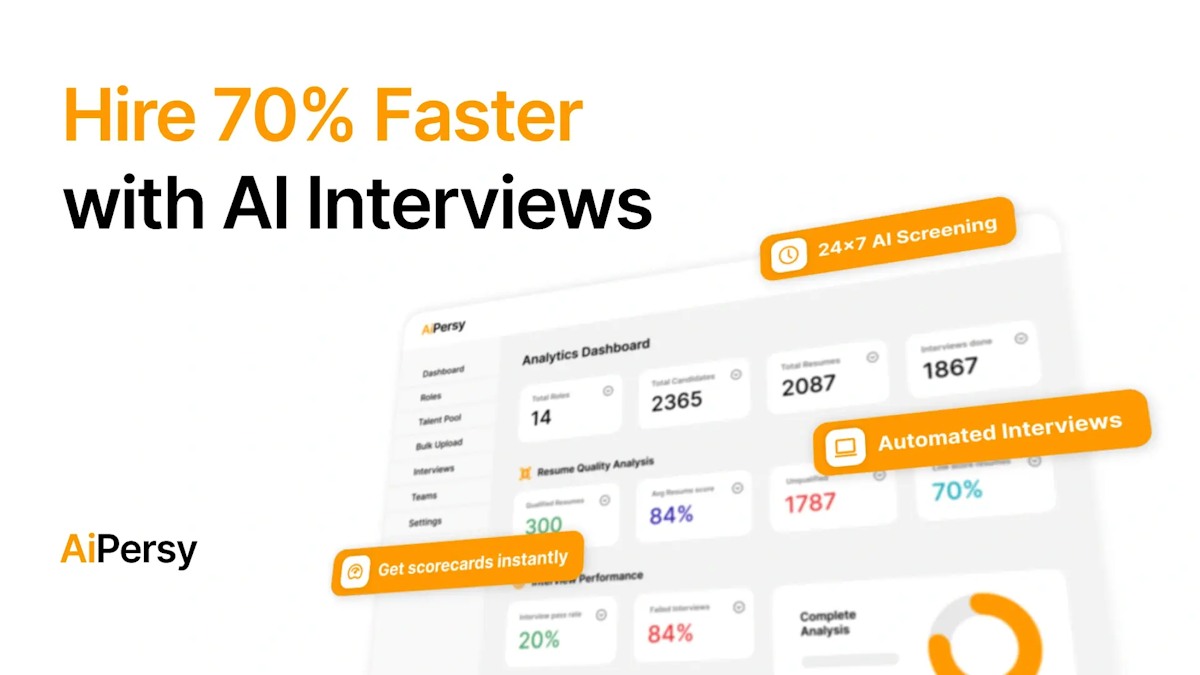
This is where AI hiring tools take over the heavy lifting: they handle screening interviews via text, audio, video, or avatar, evaluating candidates using the competencies you define.
Because these interviews run autonomously and in parallel, you can screen ten, fifty, or five hundred candidates at once, without adding any inconvenience to the recruiter’s schedule.
AI interviewer creates summaries and scorecards instantly
After screening, another bottleneck that consumes a lot of recruiters’ bandwidth is summarizing each interview.
Recruiters spend hours writing notes, highlighting strengths and concerns, formatting scorecards, and updating the ATS with context that helps hiring managers make quicker decisions.
However, this process is itself essential to keep the funnel moving, but it’s slow, recursive, and completely manual.
On the other hand, agentic AI interviewers eliminate this step by generating detailed summaries immediately after the conversation ends.
It means every response is analyzed, structured, and mapped to your competency model, resulting in clean scorecards, insights, and recommendations.
As a result, recruiters no longer need to write lengthy evaluations; they simply review the AI-generated summary and pass it on to the next touchpoint in the funnel.
This turns a traditionally slow administrative stage into an instant output.
AI improves alignment with hiring managers
Misalignment with hiring managers is one of the most underestimated causes of time-to-hire inflation.
When recruiters share inconsistent notes or incomplete context about a screening call, hiring managers take longer to form opinions or request additional screenings, leading to multiple rounds of clarification and discussion.
However, AI interviewing removes this roadblock. It ensures that each candidate’s profile is accompanied by a structured evaluation that includes clear reasoning, standardised scoring, and evidence drawn directly from their interview responses.
This gives hiring managers the clarity they need to make quick decisions and reduces the number of back-and-forth cycles required to reach consensus.
As a result, the recruiter-to-HM handoff becomes smoother, faster, and more predictable.
AI sanitises the ATS backlog
One of the biggest operational problems HR teams face is backlog, which refers to the ever-growing pile of candidates yet to be screened.
And when this volume exceeds a recruiter’s capacity, the ATS becomes a queue of missed opportunities and backlogs.
As a result, high-potential candidates sit idle, lose interest, or get hired elsewhere before the process even starts.
However, AI interviewing effectively prevents such backlogs by screening candidates the moment they apply.
Instead of waiting days for human availability, the AI ensures every applicant progresses instantly.
Your existing ATS evolves from a storage system to a real-time hiring pipeline where candidates move smoothly without pile-ups, stalled stages, or forgotten profiles.
AI preserves momentum across the hiring funnel
In the hiring and recruiting industry, momentum refers to the difference between a fast hire and a lost candidate.
In manual hiring, momentum breaks constantly in stages, like waiting for schedules to align, waiting for summaries, and waiting for hiring manager responses.
Here, every pause increases the risk that candidates will drop off or accept another offer.
That’s why AI interviews maintain uninterrupted momentum by ensuring that every step happens immediately.
For example, interviews are conducted on demand, summaries are generated instantly, and shortlists are delivered to hiring managers without delay.
Therefore, instead of long gaps between stages, the process flows continuously.
This steady pace keeps candidates engaged, improves their experience, and dramatically reduces the friction within the hiring funnel.
The compounding effect
Each advantage of harnessing an AI hiring software that we’ve read so far, be it:
- eliminating scheduling,
- automating first-round screening,
- generating instant summaries,
- improving hiring-manager alignment,
- preventing ATS backlogs,
- and preserving candidate momentum
all of them replace the recursive manual work with meaningful working hours for HR teams.
However, the real compounding effect appears when these advantages work together in harmony.
Instead of a hiring funnel weighed down by handoffs, waiting periods, and manual follow-through, the hiring process becomes a continuous, parallel system.
It means the screening process shrinks from days to hours, interview feedback becomes immediate, and hiring managers can review candidates as soon as they’re ready.
The cumulative impact of these efficiencies consistently reduces overall time-to-hire by as much as 70%, especially in high-volume, multi-role, or fast-scaling environments.
Wrapping Up
Reducing time-to-hire by 70% doesn’t happen miraculously. It’s a result of automating every touchpoint of your recruitment process with fully fledged AI hiring tools.
Such AI agents in hiring processes eliminate the hassles of doing repetitive work back and forth for HR professionals, including scheduling gaps, screening backlogs, manual summaries, stalled handoffs, and more.
An AI hiring tool runs first-round interviews the moment candidates apply, evaluates them with the criteria you define, and generates structured insights instantly.
Instead of waiting days for the process to move, your pipeline advances continuously, allowing recruiters and hiring managers to make decisions at the pace the business demands.
As hiring volumes increase and talent competition intensifies, speed isn’t just an efficiency metric; it’s a competitive advantage.
Teams that adopt AI-led interviewing aren’t just hiring faster; they’re reclaiming bandwidth to focus on deeper conversations, stronger candidate experiences, and better hiring outcomes overall.
For organizations ready to modernize their hiring engine, AI interviewing is no futuristic leap.
It’s the most practical, high-impact step toward building a recruiting process that finally moves as fast as the rest of the business.